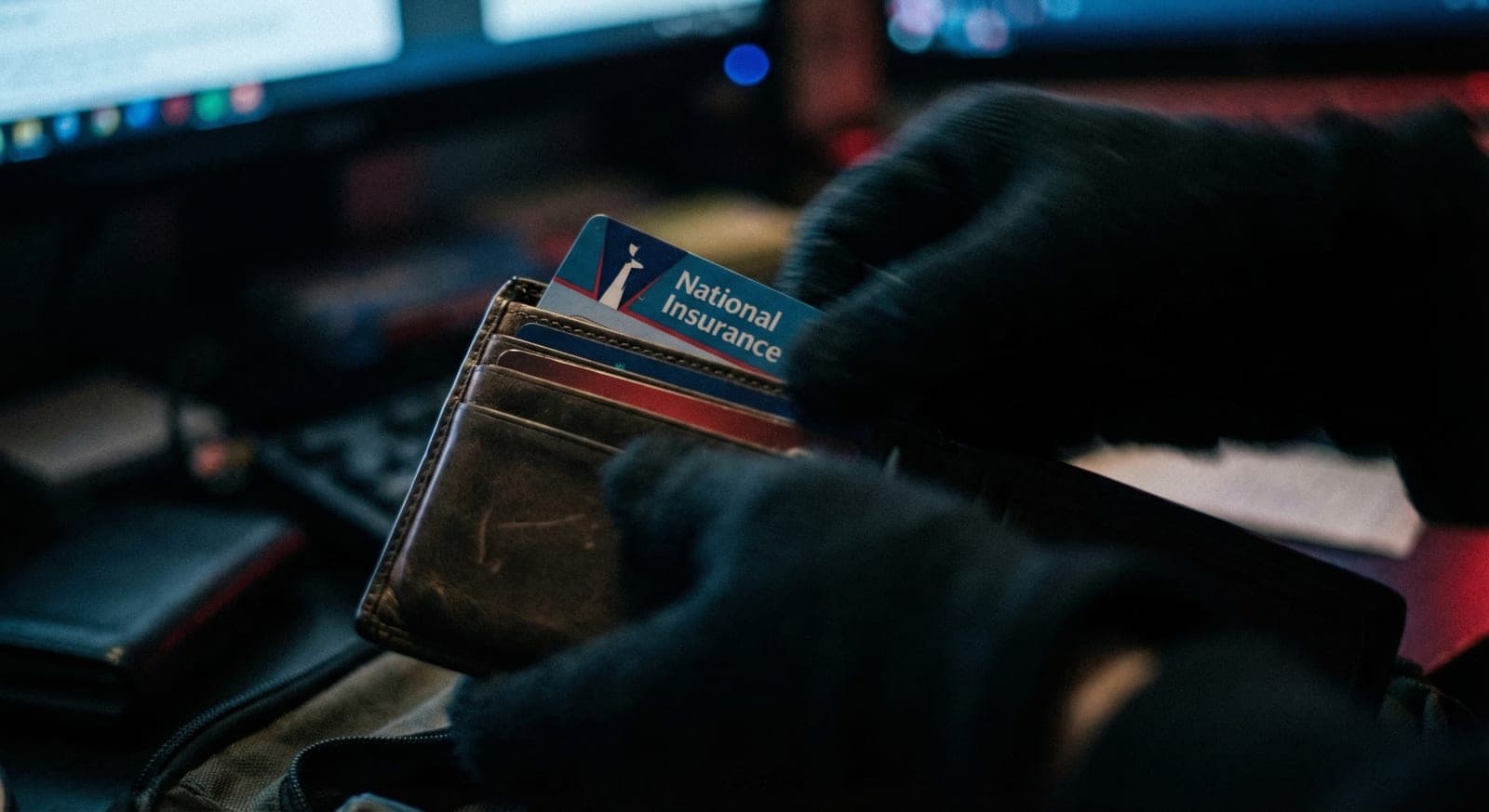
What Is a National Insurance Number (and Why Criminals Want Yours)
Your National Insurance number is a unique personal identifier issued by HMRC. It tracks your tax contributions, National Insurance payments, and entitlement to state benefits including your state pension. Every UK worker has one, and it stays with you for life.
For criminals, a stolen NI number is a golden ticket. Unlike a credit card number that can be cancelled in minutes, your NI number is permanently tied to your identity. That permanence is exactly what makes it one of the most valuable pieces of personal data on the black market.
On the employment and tax side, your number lets someone work illegally under your identity, file fraudulent tax returns, claim refunds in your name, or build fake employment records that later land on your file. On the benefits and services side, it opens the door to fraudulent Universal Credit claims, NHS services accessed under your identity, housing benefit applications, and new financial accounts. In almost every case the activity happens in your name, which means the bill, the investigation, or the overpayment notice eventually arrives at your door.
Hour 1: Report It Immediately
The moment you discover your NI number has been compromised, whether through a data breach notification, a suspicious letter from HMRC, or an unfamiliar employer appearing on your records, you must report it. Do not wait until Monday morning. Do not wait to “see if anything happens.” Act now.
Make these calls right now, in this exact order:
- HMRC fraud hotline (0300 200 3300). Report the NI number misuse, ask for a review of your tax record, and flag any employer you do not recognise.
- Action Fraud (0300 123 2040, or online at actionfraud.police.uk). Get a crime reference number and keep it somewhere safe. You will need it for every dispute that follows.
- The three credit agencies. Call Experian (0344 481 0800), Equifax (0333 321 4043), and TransUnion (0330 024 7574) and request a fraud alert on all three files.
Hours 2-6: Check Your Tax Account and Secure Everything
Once you have reported the theft, it is time to investigate the damage. Log in to your HMRC Personal Tax Account and look for warning signs. This is where most NI number fraud first becomes visible.
The clearest red flags are employers you do not recognise, tax recorded against companies you have never worked for, unexpected changes to your tax code, P45s or P60s from unknown sources, and benefits claimed that you never applied for. Any one of these means you should act immediately. While you are logged in, review your National Insurance record for gaps or contributions you cannot account for, look for correspondence you never received, and confirm that your address and bank details have not been changed.
Screenshot everything unusual
Register with CIFAS Protective Registration
CIFAS Protective Registration costs around £25 for two years and is one of the most effective fraud-prevention tools available in the UK. Once registered, any company that checks your identity through CIFAS sees a warning flag and runs additional verification before an account can be opened. It does not stop you opening legitimate accounts, but it adds a layer of checks that stops most opportunistic fraudsters in their tracks.
How Was Your NI Number Stolen?
Understanding how your number was compromised helps you close the gap and stop it happening again. Most thefts fall into two buckets. Digitally, the usual culprits are phishing emails pretending to be HMRC, data breaches at an employer or agency, unsecured emails carrying payslips or P60s, and fake job applications that ask for your NI number upfront. Physically, it is stolen post containing HMRC letters, documents thrown out with the household waste, a stolen wallet holding your NI card, or simple shoulder-surfing at an employer or agency.
The most common method in 2026 is the phishing email that mimics an HMRC tax-refund notification. Keep one rule in mind: HMRC will never email or text you asking for your National Insurance number. Anything that does is a scam, no matter how official it looks.
What Criminals Actually Do With Stolen NI Numbers
NI number fraud is not theoretical. It is happening across the UK right now, and the consequences for victims are severe. Here is what criminals do with your number and how it affects you:
Employment Fraud
This is the most common form of NI number fraud. Someone works using your National Insurance number, often in cash-in-hand jobs or through employment agencies with weak identity checks. You may only discover it when HMRC sends you a tax bill for income you never earned, or when unknown employers appear on your tax record. In severe cases, victims have found themselves owing thousands in unpaid tax.
Benefit Fraud
Criminals use stolen NI numbers to claim Universal Credit, housing benefit, and other government payments. The Department for Work and Pensions may then pursue you for the fraudulently claimed amounts. Victims have reported receiving threatening letters about overpayments they knew nothing about, and it can take months to prove you were not the claimant.
Tax Refund Fraud
Using your NI number, criminals file false tax returns claiming refunds they are not entitled to. The refund goes to their bank account, but the liability sits on your record. When HMRC eventually investigates the discrepancy, it is you who receives the investigation notice.
Stop emailing documents that carry your NI number
Payslips, P60s and tax letters all show your National Insurance number. Send them with an encrypted link that auto-deletes after download instead.
Hours 7-24: Set Up Long-Term Monitoring
Once the immediate crisis is managed, you need to set up ongoing monitoring. NI number fraud can surface weeks or months after the theft, so vigilance is what protects you in the long run.
Each week, review your bank statements for transactions you do not recognise, check your HMRC Personal Tax Account, and keep an eye out for unexpected post or email from HMRC or the DWP. Each month, request full credit reports from all three agencies, review your NI contribution record online, look for new credit applications made in your name, and confirm your address details are still correct with HMRC.
How long to keep watching
Can You Get a New National Insurance Number?
This is the question every victim asks, and unfortunately the answer is almost always no. HMRC's official position is that National Insurance numbers are issued for life and are not routinely replaced, even in cases of fraud. A new number may only be considered in exceptional circumstances where there is clear evidence of ongoing, persistent fraud that cannot be resolved any other way.
If you believe your case is exceptional, write to the National Insurance Contributions Office with your Action Fraud crime reference number, evidence of the fraud, and a clear explanation of why ongoing monitoring is insufficient. Be prepared for a lengthy process, as approvals are extremely rare.
Prevention: How to Protect Your NI Number Going Forward
Now that you understand the severity of NI number theft, here are the steps that will significantly reduce your risk of it happening again:
NI Number Protection Rules
Do This
- Use encrypted file sharing to send documents containing your NI number
- Shred any paper documents showing your NI number before disposal
- Only share your NI number with verified employers and HMRC
- Keep your NI card in a secure location at home, not in your wallet
- Use your HMRC Personal Tax Account to monitor for unusual activity
Never Do This
- Never email your NI number or documents containing it
- Never share your NI number over social media or messaging apps
- Never give your NI number to a recruiter before a confirmed job offer
- Never respond to emails or texts claiming to be from HMRC
- Never store your NI number in unencrypted digital notes
Who to Contact: Complete Reference List
Keep this list saved. If your NI number fraud escalates or you discover new issues, you will need these contacts readily available.
Essential contact numbers
- HMRC: 0300 200 3300
- Action Fraud: 0300 123 2040
- DWP fraud hotline: 0800 854 440
- NI Contributions Office: 0300 200 3500
- CIFAS: Protective Registration
- Experian: 0344 481 0800
- Equifax: 0333 321 4043
- TransUnion: 0330 024 7574
The Bottom Line
Having your National Insurance number stolen is serious, but it is not the end of the world if you act quickly. The 24-hour window after discovery is critical. Report it, check your records, set up monitoring, and take steps to prevent it from happening again.
Most importantly, stop sharing sensitive documents like payslips, P60s, and tax correspondence through unencrypted email. Every unsecured email is another opportunity for your NI number to be intercepted. Use encrypted document sharing instead.
Protect Your Documents Going Forward
When your accountant, solicitor, or employer needs sensitive documents, don't email them. Send securely instead, they'll see how professional document collection should work.
Written by the FileSeal security and compliance team. We specialise in document security, GDPR compliance, and data protection for UK professionals. Our guides are reviewed by industry practitioners and updated regularly.