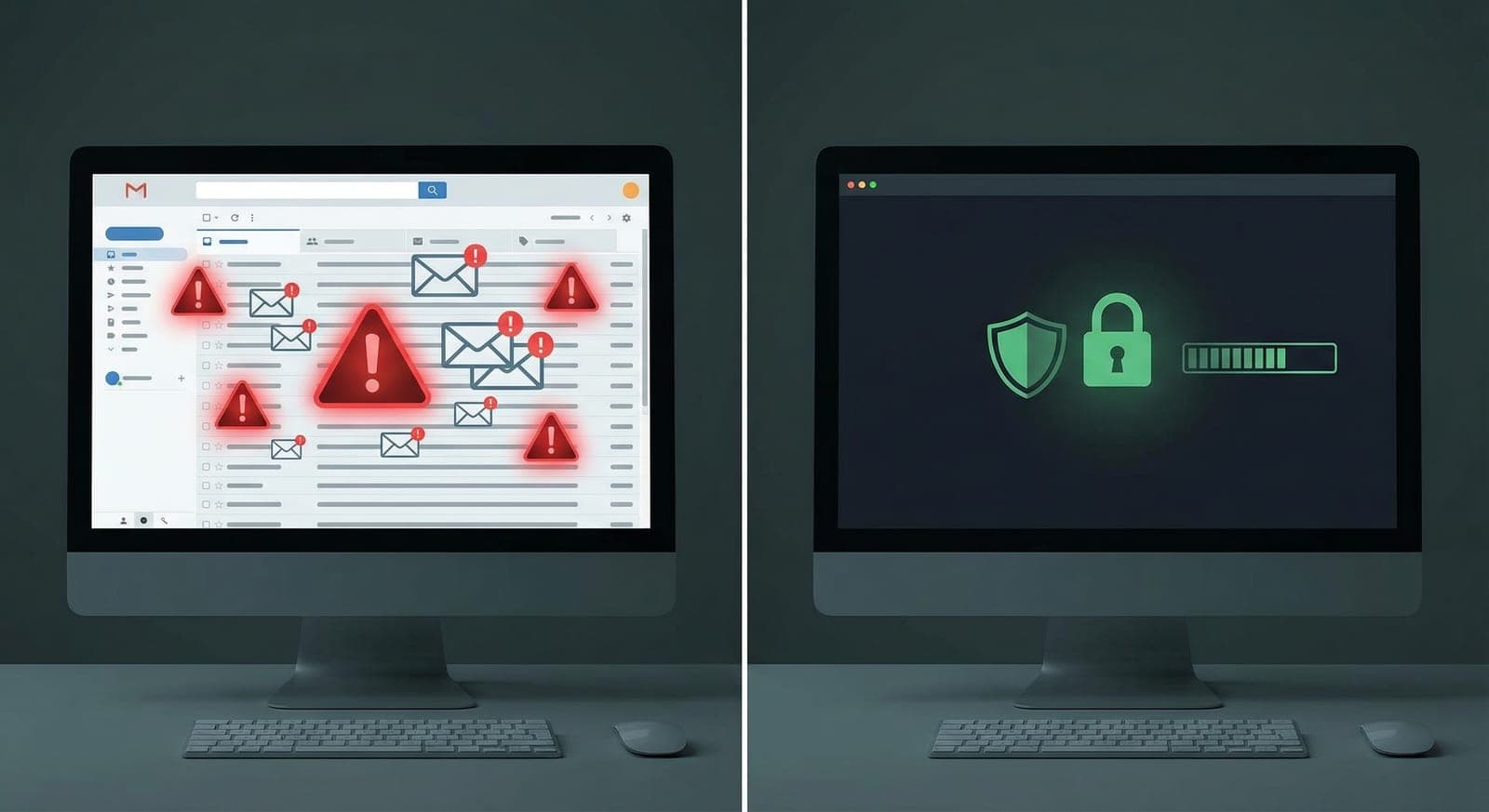
The Problem With Email Document Sharing
Every day, millions of UK professionals send sensitive documents by email. Bank statements, passport copies, tax returns, medical records, and legal contracts fly between inboxes with almost no protection. Most professionals know this feels risky, but few understand just how exposed they really are.
Email was invented in the 1970s as a digital replacement for paper memos. It was designed for convenience, not security. Yet in 2026, it remains the default method for sharing documents that could ruin lives if they fell into the wrong hands.
Encryption: The Fundamental Difference
How Email Actually Works
When you attach a document to an email, that file travels through multiple servers before reaching the recipient. At each hop, the attachment can potentially be read, copied, or intercepted. While TLS encryption protects data in transit between some servers, it does not encrypt the attachment itself. The document sits in plaintext on every mail server it passes through and on both the sender's and recipient's mail servers indefinitely.
Even with TLS, there is no guarantee every server in the chain supports it. If even one server in the relay does not use TLS, the entire attachment is transmitted in plaintext over the open internet. The sender has no way to verify whether end-to-end protection was maintained.
How Secure Document Sharing Works
Purpose-built secure document platforms use client-side encryption, meaning files are encrypted on the sender's device before they ever leave it. The encryption key never travels with the file. Even if someone intercepts the data in transit or gains access to the server, they see nothing but meaningless encrypted bytes. Only the intended recipient, using a unique secure link, can decrypt and access the document.
AES-GCM-256 vs TLS: What Is the Difference?
TLS (email): Encrypts the connection between servers, but the document itself remains unencrypted at rest. Think of it as a locked van carrying an unlocked briefcase.
AES-GCM-256 (secure platforms): Encrypts the document itself before it leaves your device. The briefcase is locked with a unique key before it travels, so nothing readable crosses the network. Who else holds a copy of that key depends on the platform and, on FileSeal, on which delivery mode you pick.
The Complete Comparison: Email vs Secure Document Sharing
The Permanent Copies Problem
When you email a document, you instantly lose control of it. The attachment now exists in at least four places: your sent folder, your mail server, the recipient's mail server, and the recipient's inbox. If the recipient forwards it, each new recipient creates another set of copies. If anyone backs up their email, those copies multiply further.
Under GDPR, data controllers must be able to delete personal data when it is no longer needed. With email, this is practically impossible. You cannot reach into someone else's inbox, their email server's backup tapes, or any forwarded copies. The data lives on, uncontrolled and untracked.
The biggest GDPR blind spot in professional-services firms isn’t the case-management system, which usually has well-defined retention rules. It’s the email attachment. A firm can have an excellent data policy on paper and then undermine it daily by emailing sensitive documents that persist indefinitely across multiple servers no policy reaches.
Secure document platforms solve this through automatic deletion. Once the recipient downloads the file, it is permanently destroyed from the server. There are no lingering copies, no backup tapes to worry about, and a clear audit trail proving deletion occurred.
GDPR Compliance Gaps in Email
The UK GDPR and Data Protection Act 2018 require organisations to implement “appropriate technical and organisational measures” to protect personal data. Email fails this test in several critical ways.
Five GDPR Failures of Email Document Sharing
Secure Your Documents Today
AES-256 encrypted upload links. Documents auto-delete after download.
The Audit Trail Gap
If a regulator asks you to prove how a client's passport copy was handled, what can you show them? With email, the answer is almost nothing. You can show the email was sent, but you cannot prove who opened the attachment, whether it was forwarded, downloaded, printed, or whether it still exists on third-party servers.
Secure document platforms keep a record of the transfer. FileSeal logs the upload, the download and the collection against the request. This gives professionals a record of each transfer to show regulators such as the SRA, FCA, and professional bodies.
Professional Image and Client Trust
Beyond security, there is a growing perception gap. Clients who bank online, use biometric authentication on their phones, and receive encrypted messages from their bank increasingly question why their solicitor or accountant is asking them to email a passport copy.
Sending a branded, secure upload link communicates professionalism instantly. It tells the client: “We take your data as seriously as your bank does.” This is a competitive advantage that costs very little to implement but significantly impacts client confidence and retention.
What Clients See: Email vs Secure Platform
Email Request
“Hi, can you email me your bank statements and a copy of your passport? Thanks.”
Client perception: Unprofessional, insecure, no protection
Secure Link Request
“I have sent you a secure upload link for your documents. Your files are encrypted and automatically deleted after we download them.”
Client perception: Professional, trustworthy, modern
ICO Enforcement: Real Consequences
The Information Commissioner's Office has made clear that email is not an acceptable method for transferring sensitive personal data without additional safeguards. Enforcement actions against professional services firms have increased significantly since 2023, with fines reaching up to 4% of annual turnover or 17.5 million pounds, whichever is higher.
Common enforcement triggers include misdirected emails (sending documents to the wrong recipient), lack of encryption for sensitive data, inability to demonstrate data minimisation practices, and failure to maintain processing records. All of these are inherent risks of email-based document sharing.
Making the Switch: What to Look For
Not all secure document platforms are created equal. When evaluating alternatives to email, UK professionals should prioritise these features:
- Client-side encryption: Files must be encrypted before leaving the sender's device, not just in transit
- UK/EU data residency: Documents should be stored within GDPR-compliant jurisdictions
- Automatic deletion: Files should be permanently destroyed after download, with no lingering copies
- Audit trails: Uploads, downloads and collections logged against the request
- White-label branding: Professional presentation with your firm's logo and colours
- Ease of use: Clients should not need to install software or create accounts
- Regulatory alignment: Built specifically for UK professional requirements
Ready to Replace Email Attachments?
FileSeal gives UK professionals encrypted document sharing designed for UK GDPR, with automatic deletion and logged client uploads, downloads and collections. No software for clients to install, no complicated setup.
Free trial with no credit card required.
The Cost of Doing Nothing
Many professionals delay the switch because email “works well enough.” But the risk calculus is changing rapidly. ICO enforcement is increasing, client expectations are rising, and professional indemnity insurers are beginning to scrutinise data handling practices more closely.
The cost of a secure document platform is typically less than one hour of a professional's billable time per month. The cost of a data breach involving emailed documents, including ICO fines, reputational damage, client loss, and remediation, can run into tens of thousands of pounds or more.
Conclusion: Email Is a Liability, Not a Solution
Email remains excellent for communication, but it was never built for secure document transfer. The gaps in encryption, the permanent copies problem, the absence of audit trails, and the GDPR compliance failures make it a professional liability for anyone handling sensitive client documents.
UK professionals who switch to purpose-built secure platforms gain encryption, compliance, audit trails, automatic deletion, and an immediate boost to their professional image. In a market where trust is everything, the method you use to handle client documents says more about your practice than any marketing campaign.
Stop Emailing Sensitive Documents
AES-256 encryption. Auto-delete after download. No client accounts needed. Designed for UK GDPR.
Written by the FileSeal security and compliance team. We specialise in document security, GDPR compliance, and data protection for UK professionals. Our guides are reviewed by industry practitioners and updated regularly.